

How to Select Bifold Door Materials for Your Home
- findnfound
- Aug 10
- 6 min read
A bifold door can make a tight kitchen feel open, divide a service yard without blocking light, or give a bathroom entrance a cleaner finish. But the material behind that transformation matters just as much as the folding mechanism. Knowing how to select bifold door materials means looking beyond the initial appearance and choosing a door that suits your room, daily routine and Singapore’s humid conditions.
A door that looks striking in a showroom may not be the right choice beside a wet bathroom, in a high-use kitchen, or across a wide opening. The best result comes from matching material, frame, panel design and hardware to the way your home actually works.
Start with the room, not the door style
Bifold doors are valued for their compact operation. Rather than swinging into the room, the panels fold neatly to one side, freeing up useful floor space. That makes them especially effective for HDB flats and condominiums, where every centimetre counts.
However, each room places different demands on the door. A bathroom or service yard needs strong moisture resistance. A kitchen may benefit from easy-clean surfaces and a design that allows light through. A bedroom, study or wardrobe opening may call for more privacy and a warmer visual character.
Before comparing finishes, consider four practical questions: Will the door be exposed to steam or splashes? How often will it be opened? Is privacy essential? And does the door need to bring daylight into a darker area? Your answers narrow the material choices quickly and prevent a design-led decision from becoming a maintenance issue later.
How to select bifold door materials by performance
For most modern homes, aluminium is the leading choice for bifold door frames. It is lightweight, stable and highly resistant to moisture, making it well suited to Singapore’s heat and humidity. Unlike timber-based materials, aluminium will not swell, warp or absorb moisture when used in the right setting.
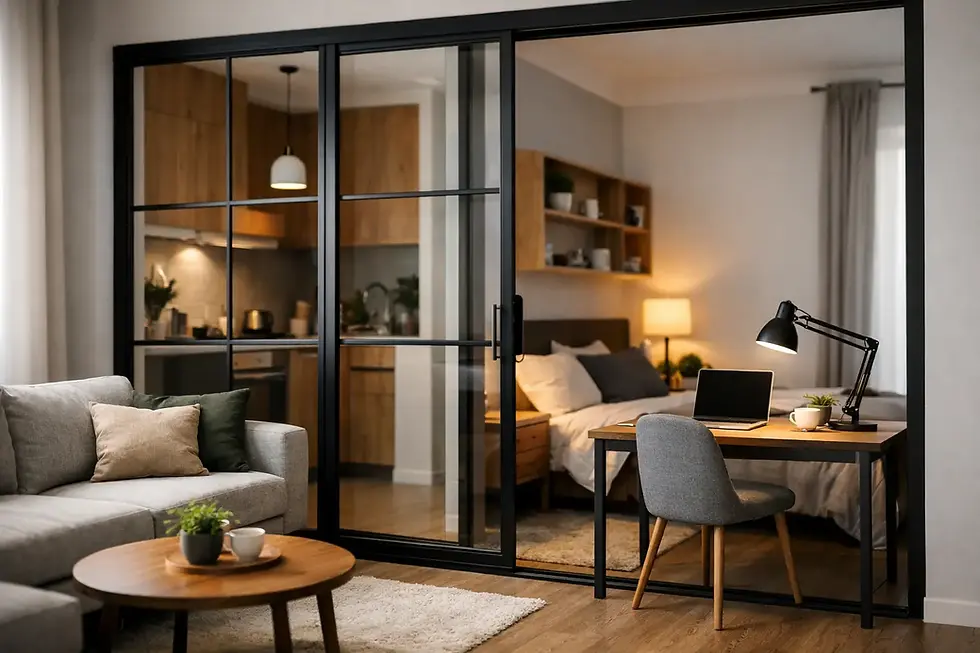
Its strength also allows for slimmer frame profiles. This is valuable when you want a larger glazed area, cleaner sightlines and a more contemporary look without making the door feel heavy. A slim black aluminium frame with fluted or frosted glass, for example, can create a refined partition between a kitchen and service yard while still keeping the space bright.
Aluminium is not a single look. Powder-coated finishes can be selected to complement pale Scandinavian interiors, dark modern schemes, industrial-inspired spaces or warmer neutral palettes. The quality of the coating matters: a well-finished surface is easier to clean and better able to retain its appearance with regular use.
Aluminium frames with glass panels
Aluminium and glass is a strong combination where brightness and visual openness are priorities. Clear glass gives the most light transfer and makes compact areas feel less enclosed. It works well for internal partitions, dry kitchens and spaces where both sides of the door are kept orderly.
For areas requiring discretion, frosted, textured or fluted glass offers a better balance. These finishes diffuse views while allowing daylight to travel through the home. Frosted glass is often preferred for bathrooms and utility zones, while fluted glass can introduce texture and a more decorative, design-forward finish.
Safety should be part of the specification, particularly for full-height or large glass panels. Ask about suitable safety glass options and ensure the panel thickness is appropriate for the door size and intended use. Glass adds elegance, but it also adds weight, so the track, hinges and rollers must be designed to support it properly.
Aluminium frames with solid panels
Solid-panel bifold doors are ideal when privacy is the main objective. They can suit toilets, storerooms, bedrooms, concealed laundry areas and any opening where you would rather hide the room beyond. Depending on the chosen finish, solid panels can look crisp and minimal or provide a more textured, timber-inspired effect.
The trade-off is light. A fully solid bifold door can make a narrow corridor or internal kitchen feel more closed off. One practical compromise is to use a solid lower panel with an obscured glazed upper section. This preserves privacy where it matters while reducing the boxed-in feel.
For wet locations, be careful with materials that use timber cores or wood-composite construction. Some may be suitable only for dry interiors, even if the outer surface looks water resistant. Always check what the panel is made from, not only the finish printed on top.
Timber and timber-look options
Real timber creates warmth that is difficult to replicate. It can be an appealing choice for dry, climate-controlled rooms where a natural grain and tactile finish are central to the interior concept. Yet it requires more care than aluminium, especially in humid environments or near water sources.
Timber can expand and contract with changing moisture levels. Over time, this may affect alignment, surface condition and how smoothly a bifold door closes. It is also typically heavier, which can place greater demands on hinges and tracks.
A timber-look aluminium or moisture-resistant panel can offer a more practical alternative for homeowners who want the visual softness of wood without the same level of upkeep. This is often the smarter route for kitchens, utility areas and compact flats where durability must work alongside style.
Do not overlook hardware and door weight
The material choice affects more than appearance. It determines the overall weight of the bifold system, and that weight directly influences the hardware required for reliable operation.
A heavier glass or solid-panel door needs quality rollers, hinges, pivots and tracks that can carry the load without dragging, rattling or dropping out of alignment. The wider the opening and the more panels involved, the more important the engineering becomes. A poorly specified system may look fine on installation day but become difficult to operate after months of repeated use.
For a busy family home, smooth operation is not a luxury. Choose hardware designed for frequent opening and closing, and ask whether the system includes adjustable components for fine-tuning alignment. Soft-close features may also be worth considering where doors are used often or where young children are present.
Match transparency to the level of privacy you need
Many material decisions come down to a simple tension: do you want the room to feel bigger, or do you want it to feel more concealed? Glass helps one space borrow light from another. Solid materials establish stronger separation.
Clear glass is best used where visual connection is a benefit. Frosted and textured glass are more versatile for homes because they retain brightness while softening visibility. Solid panels are the strongest option for privacy, but they should be selected thoughtfully in small homes where every blocked light path is noticeable.
For bathrooms, consider both modesty and maintenance. A frosted glass panel within an aluminium frame can create a modern, clean-lined appearance, but it should be paired with hardware and seals suited to a damp environment. For a service yard, materials that tolerate moisture, cleaning products and regular use will usually outperform finishes chosen purely for their decorative appeal.
Consider maintenance before committing to a finish
No door material is entirely maintenance-free, but some are far more forgiving than others. Aluminium frames generally need only routine wiping with a soft cloth and mild cleaner. Glass will show water marks and fingerprints more readily, particularly in high-touch areas, but it is simple to clean with the right products.
Textured and fluted glass can be more forgiving visually than clear glass, though grooves may need occasional attention. Dark frames make a sharp design statement, but dust and residue can be more visible than on lighter finishes. White and neutral tones are often easier to blend into a home, although they should still be chosen in a quality coating that resists yellowing and staining.
Avoid abrasive pads and harsh chemicals that may damage coatings, seals or glass surfaces. Good care protects the finish, but correct material selection does most of the work from the start.
Choose made-to-measure for a better fit
Bifold doors depend on accurate measurements. A small issue with wall alignment, floor level or opening width can affect how panels fold, meet and lock. This is why made-to-measure fabrication and professional installation are especially valuable for older flats, irregular openings and wide kitchen entrances.
A proper site assessment should account for the finished floor level, surrounding tiles, ceiling clearance, opening direction and nearby cabinetry. It should also establish whether you need a top-hung or bottom-track arrangement, based on the structural conditions and the desired look. The right configuration keeps the door practical without compromising the visual flow of the room.
At Ministry of Door, the focus is on pairing tailored aluminium door systems with practical installation advice, so the final result feels considered rather than adapted to fit.
The most satisfying bifold door is one you barely have to think about: it opens smoothly, handles daily moisture and traffic, gives the right level of privacy, and makes the room feel better every time you walk through it. Choose the material for the life you live, and the design will have a far better chance of staying beautiful.


Comments