
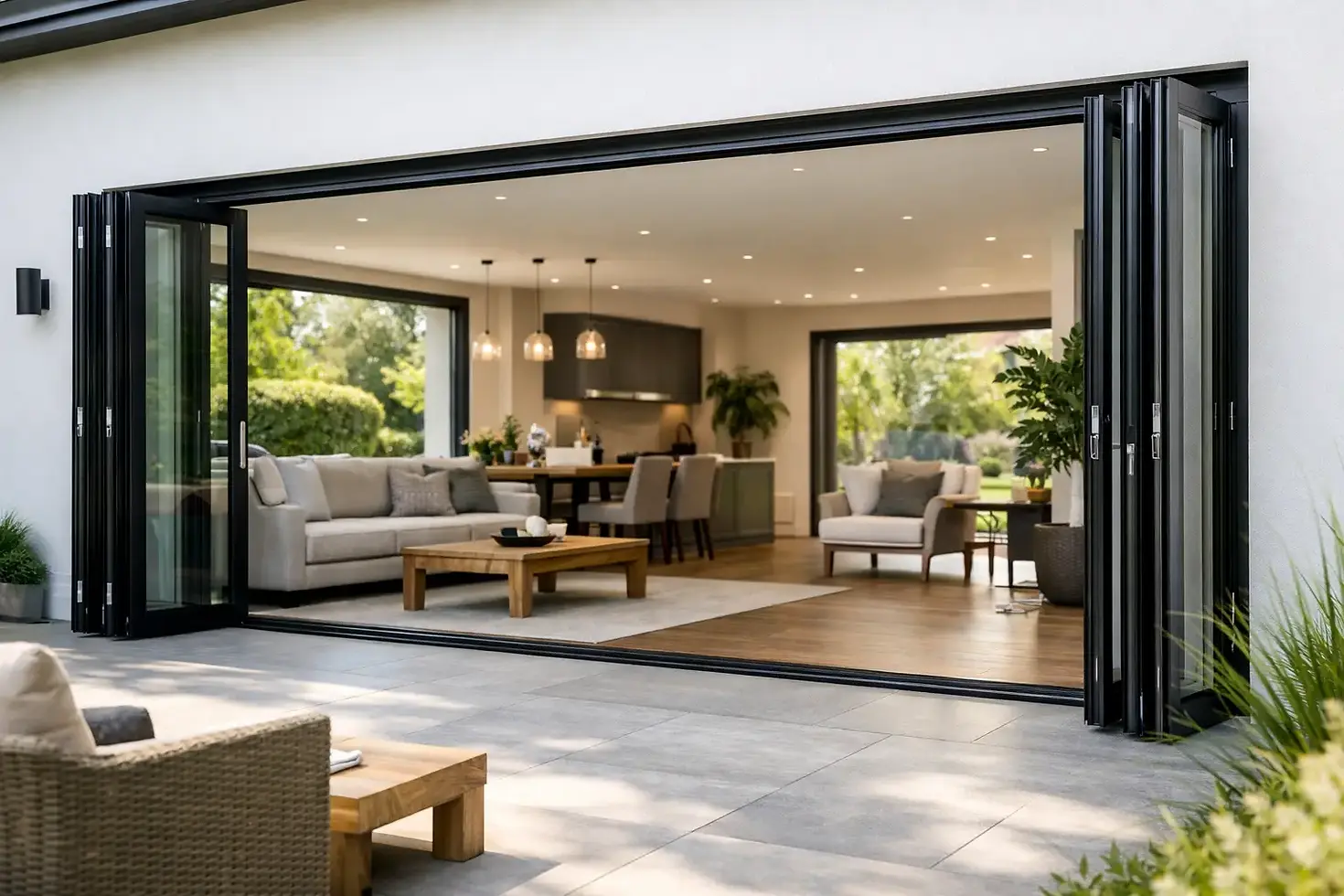
Can Bifold Doors Fit Wide Openings?
A wide opening can be a brilliant feature right up until you need to close it off. Open-plan kitchens, service yards, balconies, patio entries and broad room dividers all look generous when left open, but they still need privacy, weather control or clear zoning when required. If you are asking can bifold doors fit wide openings, the short answer is yes - but only when the system is properly designed for the width, usage and structure of the space.
That is where many homeowners get stuck. A wide span is not simply a standard door made bigger. The panel count, frame strength, track system, stacking direction and daily use all affect whether bifold doors will feel smooth and elegant, or heavy and awkward after a few months.
Can bifold doors fit wide openings in real homes?
They can, and in many cases they are one of the smartest ways to handle a larger-than-average opening without wasting swing space. Bifold doors are designed to fold and stack to one or both sides, so they can cover broad widths while keeping the passage relatively open when retracted.
In Singapore homes, this matters more than people expect. A wide kitchen entrance, a yard separation, a balcony threshold or a flexible partition between living and dining zones often needs something lighter than a full wall and more space-efficient than multiple swing leaves. Bifold systems work well because they give closure without making the room feel boxed in.
The key point is that width alone does not decide suitability. A wide opening can often be fitted successfully, but the door system must be customised around proportion, panel weight and how often the opening will be used.
What makes a wide opening suitable for bifold doors?
The first factor is the actual width and height of the opening. Wider spans usually mean more panels rather than oversized individual leaves. That keeps each panel manageable and helps the system fold neatly instead of becoming bulky and difficult to operate.
The second factor is the frame and track design. Aluminium is especially useful here because it offers a clean, modern look while staying lighter and more moisture-resistant than many other materials. In humid environments such as kitchens, bathrooms, yards and sheltered outdoor areas, this makes a practical difference over time.
The third factor is structural support. A door can only perform as well as the opening allows. If the floor is uneven, the wall surfaces are out of line or the lintel is not suitable for the chosen system, the installation may look acceptable at first but develop alignment issues later. For wide bifold doors, precise site measurement is not a nice extra. It is part of the product.
Panel configuration matters more than people think
When customers picture bifold doors for a wide opening, they sometimes imagine two large folding panels meeting in the middle. In practice, that is rarely the best setup. The cleaner solution is often a higher number of narrower panels arranged to distribute weight more evenly.
This is where custom fabrication becomes valuable. A made-to-measure system can be planned so the folds stack where they interfere least with furniture, counters, walkways or cabinetry. For example, a broad kitchen entrance may work better with panels stacking to one side, while a patio opening may benefit from a split opening that allows a centred access point.
There is always a balance to strike. More panels can improve manageability and coverage for very wide spans, but they also create more vertical lines when the door is closed. Fewer panels create a simpler look, but individual leaves become wider and heavier. The right answer depends on whether your priority is minimal framing, everyday convenience or maximum opening width.
Where wide bifold doors work especially well
In residential settings, wide bifold doors are often chosen for spaces that need flexibility rather than a permanent barrier. They are particularly effective between kitchens and yards, living rooms and balconies, dining areas and study corners, or as wardrobe and storage enclosures where a broad access area is useful.
For HDB flats and condominiums, the space-saving quality is often the real selling point. A swing door needs clearance. A sliding door needs wall run. A bifold door folds within its own footprint, which can be a practical advantage when every bit of circulation space counts.
In landed properties, wider openings are more common, especially for patios, utility zones and internal transitions. Here, design matters just as much as function. Slim-profile aluminium bifold systems can help a large opening look intentional and refined instead of purely utilitarian.
Commercial interiors can also benefit, particularly where operators want to divide spaces without installing a fixed wall. The same principle applies: the wider the opening, the more important the design and hardware specification become.
When bifold doors may not be the best choice
Not every wide opening should automatically get a bifold door. If the span is extremely large and you want an almost uninterrupted view, a sliding system may suit the design better. If the opening is used constantly by children, elderly family members or staff carrying items through all day, the folding action and stacked panels may be less convenient than a simpler opening method.
There is also the question of threshold design. Some wide bifold systems need a bottom track that homeowners may find less desirable in certain areas. Others can be configured differently, but that depends on the application and the required stability.
Aesthetic preference matters too. Bifold doors create multiple panel lines. Some homeowners love the rhythm and structure this adds. Others prefer broader glass sections or fewer divisions. Good design is not only about what fits physically, but what fits the overall mood of the home.
How to tell if your opening needs a custom solution
If your opening is unusually wide, slightly uneven or part of a renovation with built-in carpentry nearby, assume that a custom solution will give better results than an off-the-shelf one. This is especially true when the door needs to align with kitchen cabinets, wall finishes, shower screens or wardrobe systems.
A proper assessment should look at more than width. The installer should check floor level, side wall condition, ceiling or lintel support, clearance for folding panels and the direction of movement. These details affect how polished the final result looks and how reliably it performs.
This is one reason many homeowners prefer an end-to-end supplier instead of buying a product separately and leaving the rest to chance. For wide openings, measurement, fabrication and installation are closely connected. If one part is inaccurate, the whole system suffers.
Design choices that improve the final result
If you want wide bifold doors to feel premium rather than purely functional, proportion is everything. Slim aluminium framing can keep the overall look lighter, especially in modern interiors. Glass or acrylic inserts can help preserve brightness between zones, while solid panels offer more privacy for utility areas or bathrooms.
Colour also matters more than people assume. A black or charcoal frame can sharpen the opening and create contrast in a lighter interior. White or soft neutral finishes usually blend more quietly into HDB and condominium homes. The best choice depends on whether you want the door to stand out as a design feature or disappear into the background.
Hardware should not be treated as an afterthought. On a wide opening, smooth rollers, durable hinges and accurate alignment are what make the system feel effortless. Beautiful door design only delivers the right mood when it also opens and closes cleanly.
So, can bifold doors fit wide openings without compromising style?
Yes - and often very effectively. The reason bifold doors remain popular is that they solve a practical problem while still offering a clean architectural look. They can close off a broad space, fold back neatly and adapt to layouts where swing and sliding options are less efficient.
But the successful version is never based on width alone. It comes from choosing the right panel arrangement, the right aluminium system, the right track setup and the right team to measure and install it properly. For homeowners who want a space to feel both beautiful and usable, that detail is what turns a large opening from a challenge into a feature.
If you are planning around a wide span, do not ask only whether a bifold door can fit. Ask how it should fit, how it should move and how you want the space to feel every day after the renovation dust has settled.


Comments